expressjs-field-validator
A powerful, lightweight Express.js middleware for validating request fields (body, query, params, headers) with a fluent, chainable API. Zero dependencies, full TypeScript support, and automatic API documentation generation.
Key Features:
- 🔒 Comprehensive Validation - Validate strings, numbers, emails, UUIDs, dates, booleans, arrays, and nested objects
- ⛓️ Fluent API - Chain validation rules for readable, maintainable code
- 📝 Auto-generated API Docs - Generate beautiful HTML documentation from your validation rules
- 🧹 Data Sanitization - Clean up requests with
cleanUp()andremoveIfEmpty() - 🎯 Flexible Error Handling - Reject requests or forward errors to your handlers
- 📦 Zero Dependencies - Lightweight with no external runtime dependencies
- 💪 TypeScript Ready - Full type definitions included
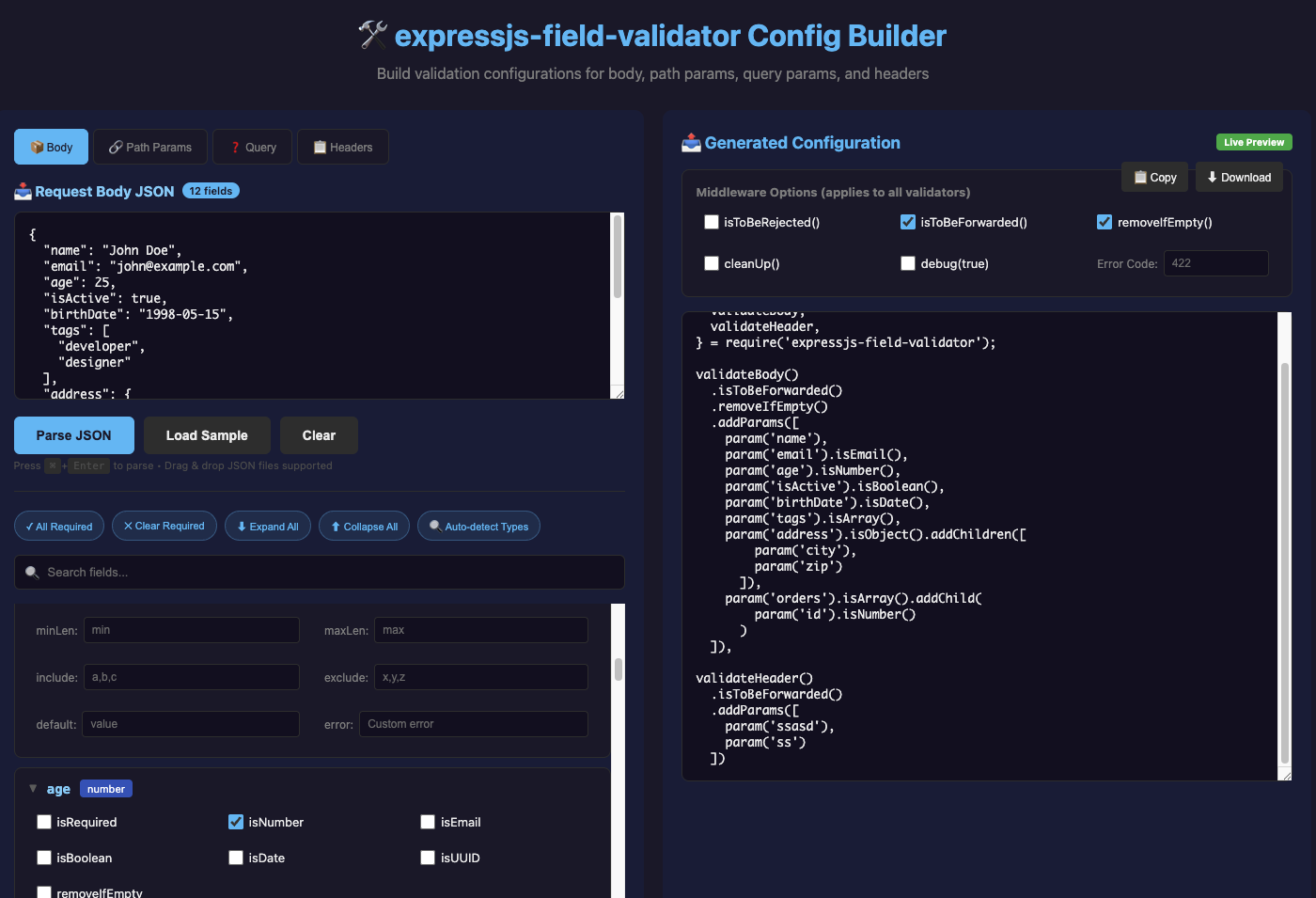
🛠️ Config Builder Tool - Generate validation configs visually!
- Installation
- How To Use
- Getting Started
- Defining a Field
- Available Options
- isRequired()
- isArray()
- isObject()
- isNumber()
- isEmail()
- isUUID()
- isMatching(regex)
- isBoolean()
- isDate()
- dateFormat(format)
- minimumNumber(min)
- maximumNumber(max)
- minimumLength(min)
- maximumLength(max)
- shouldInclude(inclues)
- shouldExclude(excludes)
- isMobileNumberWithCountryCode(countryCode)
- isMobileNumberWithCountryCodeMandatory()
- isMobileNumberWithMinimumLength(min)
- isMobileNumberWithMaximumLength(max)
- addChild(child)
- addChildren(children)
- sendErrorMessage(message)
- convertToFormat(format)
- defaultValue(value)
- removeIfEmpty()
- Available Options
- Creating a validation middleware
- Defining a Field
- Dealing with nested objects
- API Documentation Generator
- Migration Guide
Installation
$ npm install expressjs-field-validator
How To Use
 const {
  validateBody,
  validateParam,
  validateQuery,
  param,
} = require('expressjs-field-validator');
router.post('/users/:id',
validateParam().addParams([
  param('id').isNumber()
]),
validateBody().addParams([
  param('userId').isNumber()
]),
validateQuery().addParams([
  param('userName').isRequired()
]),
validateHeader().addParams([
  param('Authorization').isRequired()
]),
(req, res, next) => {

  // Main Service Here

});
Getting Started
Defining a Field
Use param(<field Name>) to define a field.
param('userName').isRequired()
Defines a field userName which is mandatory.
Available Options
isRequired()
Field is mandatory
isArray()
Expects array
isObject()
Expects object
isNumber()
Expects number
isEmail()
Expects email
isUUID()
Expects UUID string
isMatching(regex)
regexMandatory — ARegExpobject or a regex pattern string
Validates that the field value matches the provided regular expression. The value is coerced to a string before testing.
// Using a RegExp object
param('code').isRequired().isMatching(/^[A-Z]+-\d+$/)

// Using a pattern string
param('postalCode').isRequired().isMatching('^\\d{5}$')
isBoolean()
Expects boolean value
isDate()
Expects a date with default format YYYY-MM-DD
dateFormat(format)
formatMandatory String specify date format, supportedYYYY-MM-DD DD-MM-YYYY MM-DD-YYYY YYYY/MM/DD DD/MM/YYYY MM/DD/YYYYconvertToFormat(format)
formatMandatory String Converts a validated date value to the specified format. Must be used withisDate(). The source format is determined bydateFormat()(defaults toYYYY-MM-DDif not set).
Supported formats are the same as dateFormat:
YYYY-MM-DD
DD-MM-YYYY
MM-DD-YYYY
YYYY/MM/DD
DD/MM/YYYY
MM/DD/YYYY
If the specified format is not in the supported list, the conversion is silently skipped and the original value is preserved.
// Convert DD/MM/YYYY input to YYYY-MM-DD
param('birthDate').isDate().dateFormat('DD/MM/YYYY').convertToFormat('YYYY-MM-DD')
// Input: "25/12/2024" → Value after validation: "2024-12-25"

// Convert with default source format (YYYY-MM-DD) to DD-MM-YYYY
param('eventDate').isDate().convertToFormat('DD-MM-YYYY')
// Input: "2024-12-25" → Value after validation: "25-12-2024"
minimumNumber(min)
minMandatory Number Expects number and must be greater than or equal tominmaximumNumber(max)
maxMandatory Number Expects number and must be less than or equal tomaxminimumLength(min)
minMandatory Number Expects number/string and length must be less than or equal tominmaximumLength(max)
maxMandatory Number Expects number/string and length must be less than or equal tomaxshouldInclude(inclues)
incluesMandatory Array Expects number/string and must be one of given arrayincludesshouldExclude(excludes)
excludesMandatory Array Expects number/string and must not be one of given arrayexcludesisMobileNumberWithCountryCode(countryCode)
countryCodeMandatory String Expects mobile number with or withoutcountryCodeisMobileNumberWithCountryCodeMandatory()
Expects mobile number which should starts with the country code set with
isMobileNumberWithCountryCodeisMobileNumberWithMinimumLength(min)
minMandatory Number Minimum length of mobile number without country codeisMobileNumberWithMaximumLength(max)
maxMandatory Number Maximum length of mobile number without country codecustomValidator(function)
functionMandatory Function A function with arguments (value,req,error)valueis the value of the fieldreqrequest objecterrorfunction with takes error message, should be called on error(value, req, error) => { if (value !== 100) { error('Invalid value customValidator'); } }addChild(child)
childMandatory field definition object Add a child object for arrays and objectsaddChildren(children)
childrenMandatory Array of field definition objects Add a list of children objects for arrays and objectssendErrorMessage(message)
messageMandatory String Custom message to be send back in case of validation failure// Default message { "error": [ { "location": "body.sort", "param": "sort", "message": "Invalid Field Error" } ] } // Custom message { "error": [ { "location": "body.sort", "param": "sort", "message": "<Your Custom Error Message>" } ] }defaultValue(value)
valueMandatory Any value (non-array, non-object) Sets a default value for the field when the current value isundefined,null, or''(empty string). Only applies to fields that are not arrays or objects.param('status').defaultValue('active') param('count').isNumber().defaultValue(0)removeIfEmpty()
Removes the field key from the request if the value is considered empty.
- For arrays: removes if
[] - For objects: removes if
{} - For other fields: removes if
undefined,null, or''param('status').removeIfEmpty() param('items').isArray().removeIfEmpty() param('meta').isObject().removeIfEmpty()Note: When both
defaultValueandremoveIfEmptyare used together,defaultValueis applied first. If the default value is non-empty, the field is kept.param('status').defaultValue('active').removeIfEmpty() // field is kept with value 'active'Creating a validation middleware
validateBody()Validate bodyvalidateParam()Validate paramvalidateQuery()Validate queryvalidateHeader()Validate header
Available Options
isToBeRejected()
Defines the validation failure event - Server returns http status code set via sendErrorCode (default 422), :heavy_exclamation_mark: will not proceed to the next middleware
Response body
{
"error": [
{
"location": "body.sort",
"param": "sort",
"message": "Invalid Field Error"
}
]
}
isToBeForwarded()
Defines the validation failure event - Error is set to request.locals.data and error code to request.locals.statusCode, :white_check_mark: will proceed to the next middleware
Error object
Response body
{
"error": [
{
"location": "body.sort",
"param": "sort",
"message": "Invalid Field Error"
}
]
}
checkService
const { checkService } = require('expressjs-field-validator');
Pass middleware to checkService, which must be skipped if isToBeForwarded enabled and validation errors are found
router.get('/users/:id',
validateBody().isToBeForwarded().sendErrorCode(500).debug(false).addParams([
param('id').isRequired().isNumber()
]),
checkService((req, res, next) => {
// This middleware is skipped if id is empty or not a number
}),
(req, res, next) => {
// This middleware Will not be skipped, error data will be availble here - req.locals.data and status code - request.locals.statusCode here
});
skipService
manually invoke forward mode, if this is set from any middleware, the middlewares wrapped inside checkService won’t be executed
const { skipService } = require('expressjs-field-validator');
router.get('/users/:id',
(req, res, next) => {
skipService(req, 'SOME-ERROR');
next();
}),
checkService((req, res, next) => {
// This middleware is skipped
}),
(req, res, next) => {
// This middleware Will not be skipped, error data will be availble here - req.locals.data and status code - request.locals.statusCode here
});
sendErrorCode(errorCode)
errorCodeMandatory Error code which should be rejecteddebug(isDebugEnabled)
isDebugEnabledMandatory Passtruefor development environments, the error object will contain more details about error Error object{ "error": [ { "location": "body.sort", "param": "sort", "message": "Invalid Field Error :: somevalueforsort Must Be A Boolean" // More details on error } ] }removeIfEmpty()
Applies
removeIfEmptybehavior to all fields in the validation middleware. When enabled:- Arrays: removed if
[] - Objects: removed if
{} - Other fields: removed if
undefined,null, or''
This is a convenience method to avoid adding removeIfEmpty() to each field individually.
// Instead of adding removeIfEmpty() to each field:
validateBody().addParams([
param('name').removeIfEmpty(),
param('email').removeIfEmpty(),
param('phone').removeIfEmpty(),
])
// You can add it once at the top level:
validateBody().removeIfEmpty().addParams([
param('name'),
param('email'),
param('phone'),
])
Note: Field-level
removeIfEmpty()can still be used when you only want to remove specific fields.cleanUp()
Removes any keys from the request that are not declared in the validation params. This sanitizes the input to only include explicitly defined fields. Works recursively on nested objects and arrays.
// Request body: { name: "John", email: "john@test.com", hackAttempt: "malicious", extra: "data" } validateBody().cleanUp().addParams([ param('name').isRequired(), param('email').isEmail(), ]) // After validation, req.body will only contain: { name: "John", email: "john@test.com" } // The "hackAttempt" and "extra" keys are removedThis is useful for:
- Security: Preventing unexpected fields from being processed
- Data sanitization: Ensuring only declared fields reach your business logic
- API consistency: Keeping request payloads clean
Note:
cleanUp()also works recursively on nested objects and arrays defined withaddChild()oraddChildren().addParams(paramList)
paramListMandatory Array of field definition objectsvalidateBody().addParams([ // Add List of definition here param('field1').isRequired(), ])Definintion of a field here : Defining a Field
Dealing with nested objects
Request body
{ "field1": "Value", // String, Mandatory "field2": [ // array, Mandatory { "field21": "44443" }, // object Optional, number mandatory { "field21": "44443" } ], "field3": { // Object Optional "field31": "true", // Boolean Mandatory "field32": "String" // String Mandatory }, "field4": [ // array, Mandatory 123, 445, 3434 // Number Optional ], }Should send http status code 500 in case of error
Validation
```js router.post(‘/users/:id’, validateBody().isToBeRejected().sendErrorCode(500).addParams([ param(‘field1’).isRequired(), param(‘field2’).isRequired().isArray().isRequired().addChild( param(‘field2-array’).isObject().addChild( // field2-array is for tracking, you can give any name here param(‘field21’).isNumber().isRequired() ) ), param(‘field3’).isObject().addChildren([ param(‘field31’).isBoolean().isRequired(), param(‘field32’).isRequired() ]), param(‘field4’).isRequired().isArray().isRequired().addChild( param(‘field4-array’).isNumber() ), ]), validateParam().isToBeRejected().sendErrorCode(500).addParams([ param(‘field1’).isRequired(), ]), // define validateQuery(), // define validateHeader(), (req, res, next) => {
// Main Service Here
});
## API Documentation Generator
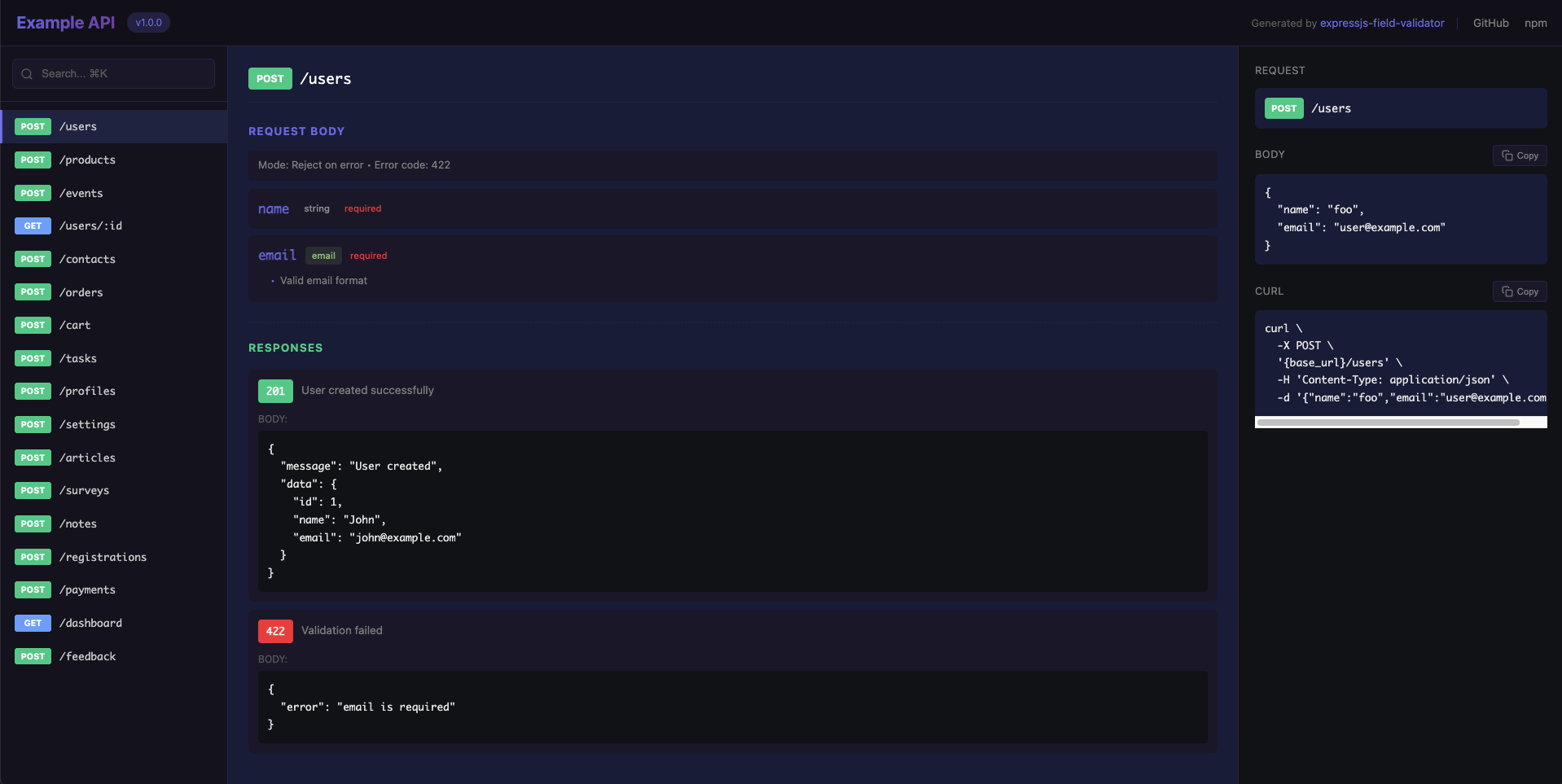
Automatically generate beautiful HTML documentation for your API endpoints. The generator extracts all routes with validation middlewares and creates an interactive documentation page.
### documentResponse()
Use `documentResponse()` to document the possible responses for an endpoint. This is a pass-through middleware that attaches response metadata for documentation generation. Place it after validation middleware but before your route handler.
```js
const { documentResponse } = require('expressjs-field-validator');
app.post('/users',
validateBody().isToBeRejected().addParams([
param('name').isRequired(),
param('email').isRequired().isEmail(),
]),
documentResponse({
201: {
description: 'User created successfully',
body: { message: 'User created', data: { id: 1, name: 'John' } },
headers: { 'X-Request-Id': 'uuid' }
},
422: {
description: 'Validation failed',
body: { error: 'Validation failed', details: [] }
}
}),
(req, res) => res.status(201).send({ message: 'User created' })
);
Response Configuration Options
| Option | Type | Description |
|---|---|---|
description |
string |
Description of the response |
body |
any |
Sample response body |
headers |
object |
Response headers as key-value pairs |
Note: Status codes must be valid HTTP status codes (100-599). The middleware throws an error for invalid status codes.
Usage
const express = require('express');
const {
validateBody,
validateQuery,
param,
generateDocs
} = require('expressjs-field-validator');
const app = express();
// Define your routes with validation
app.post('/users',
validateBody().isToBeRejected().addParams([
param('name').isRequired(),
param('email').isRequired().isEmail(),
]),
(req, res) => res.status(201).send({ message: 'User created' })
);
app.get('/users/:id',
validateQuery().isToBeRejected().addParams([
param('include').shouldInclude(['profile', 'settings', 'posts']),
]),
(req, res) => res.send({ user: {} })
);
// Generate documentation AFTER all routes are registered
generateDocs(app, {
title: 'My API',
version: '1.0.0',
outputDir: './docs',
filename: 'api-docs.html'
});
app.listen(3000);
Options
| Option | Type | Default | Description |
|---|---|---|---|
outputDir |
string |
'./docs' |
Output directory for the generated HTML file |
filename |
string |
'api-docs.html' |
Output filename |
title |
string |
'API Documentation' |
Documentation title |
version |
string |
- | API version to display |
Features
- 🎨 Beautiful dark theme with syntax highlighting
- 🔍 Search functionality to filter endpoints
- 📊 Statistics showing endpoint counts by method
- 📋 Detailed field information including types, constraints, and nesting
- 📝 Sample request body with copy-to-clipboard functionality
- 🎯 Response config display (mode, error codes, cleanUp, etc.)
- 📱 Responsive design for mobile viewing
Hosting API Documentation
You can serve the generated HTML documentation using Express static middleware:
const express = require('express');
const path = require('path');
const { generateDocs, validateBody, param } = require('expressjs-field-validator');
const app = express();
app.use(express.json());
// Define your API routes
app.post('/users',
validateBody().isToBeRejected().addParams([
param('name').isRequired(),
param('email').isRequired().isEmail(),
]),
(req, res) => res.status(201).send({ message: 'User created' })
);
// Generate documentation
generateDocs(app, {
title: 'My API',
version: '1.0.0',
outputDir: './docs'
});
// Serve the documentation at /api-docs
app.use('/api-docs', express.static(path.join(__dirname, 'docs')));
app.listen(3000, () => {
console.log('Server running on http://localhost:3000');
console.log('API Docs available at http://localhost:3000/api-docs/api-docs.html');
});
Alternative: Serve docs at root path
// Serve docs at /docs endpoint
app.use('/docs', express.static(path.join(__dirname, 'docs')));
// Or redirect /docs to the HTML file directly
app.get('/docs', (req, res) => {
res.sendFile(path.join(__dirname, 'docs', 'api-docs.html'));
});
Production Tips:
- Add caching headers for better performance
- Use environment variables to conditionally enable docs (disable in production if needed)
- Consider adding authentication to protect internal API documentation
// Only serve docs in non-production
if (process.env.NODE_ENV !== 'production') {
app.use('/api-docs', express.static(path.join(__dirname, 'docs')));
}
Migration Guide
Migrating from v3.x to v4.x
Breaking Changes
1. end() removed from field definitions
end() is no longer required (or available) when defining fields with param().
- param('userName').isRequired().end()
+ param('userName').isRequired()
- param('field21').isNumber().isRequired().end()
+ param('field21').isNumber().isRequired()
2. done() removed from validation middleware
done() is no longer required (or available) when creating validation middleware.
- validateBody().addParams([
- param('field1').isRequired().end(),
- ]).done()
+ validateBody().addParams([
+ param('field1').isRequired(),
+ ])
- validateParam().isToBeRejected().sendErrorCode(500).addParams([
- param('id').isNumber().end(),
- ]).done()
+ validateParam().isToBeRejected().sendErrorCode(500).addParams([
+ param('id').isNumber(),
+ ])
Full Before / After Example
v3.x
router.post('/users/:id',
validateParam().addParams([
param('id').isNumber().end()
]).done(),
validateBody().isToBeRejected().sendErrorCode(500).addParams([
param('name').isRequired().end(),
param('email').isEmail().end(),
param('role').shouldInclude(['admin', 'user']).end(),
]).done(),
(req, res, next) => {
// Main Service
});
v4.x
router.post('/users/:id',
validateParam().addParams([
param('id').isNumber()
]),
validateBody().isToBeRejected().sendErrorCode(500).addParams([
param('name').isRequired(),
param('email').isEmail(),
param('role').shouldInclude(['admin', 'user']),
]),
(req, res, next) => {
// Main Service
});
New Features
The following features are new in v4.x:
defaultValue(value)
Sets a default value for a field when the value is undefined, null, or ''.
param('status').defaultValue('active')
param('count').isNumber().defaultValue(0)
removeIfEmpty()
Removes the field key from the request if the value is empty.
param('notes').removeIfEmpty()
param('tags').isArray().removeIfEmpty()
convertToFormat(format)
Converts a validated date to a different format. The original value in the request is replaced with the converted value.
param('birthDate').isDate().dateFormat('DD/MM/YYYY').convertToFormat('YYYY-MM-DD')